Visual Literacy Exhibition
Poster Design, Visual Identity, Exhibition Design
🏆 1 x Gold ADC Talent Award Germany 2025
👁️ Exhibited at Galerie 5020 Salzburg
👁️ Exhibited at ADC Awardshow Hamburg 2025
2024 (Salzburg)
Supervision: Viktoria Kirjuchina, Johanna Wicht
Realized at Kommunikationsdesign FH Salzburg
Supervision: Viktoria Kirjuchina, Johanna Wicht
Realized at Kommunikationsdesign FH Salzburg

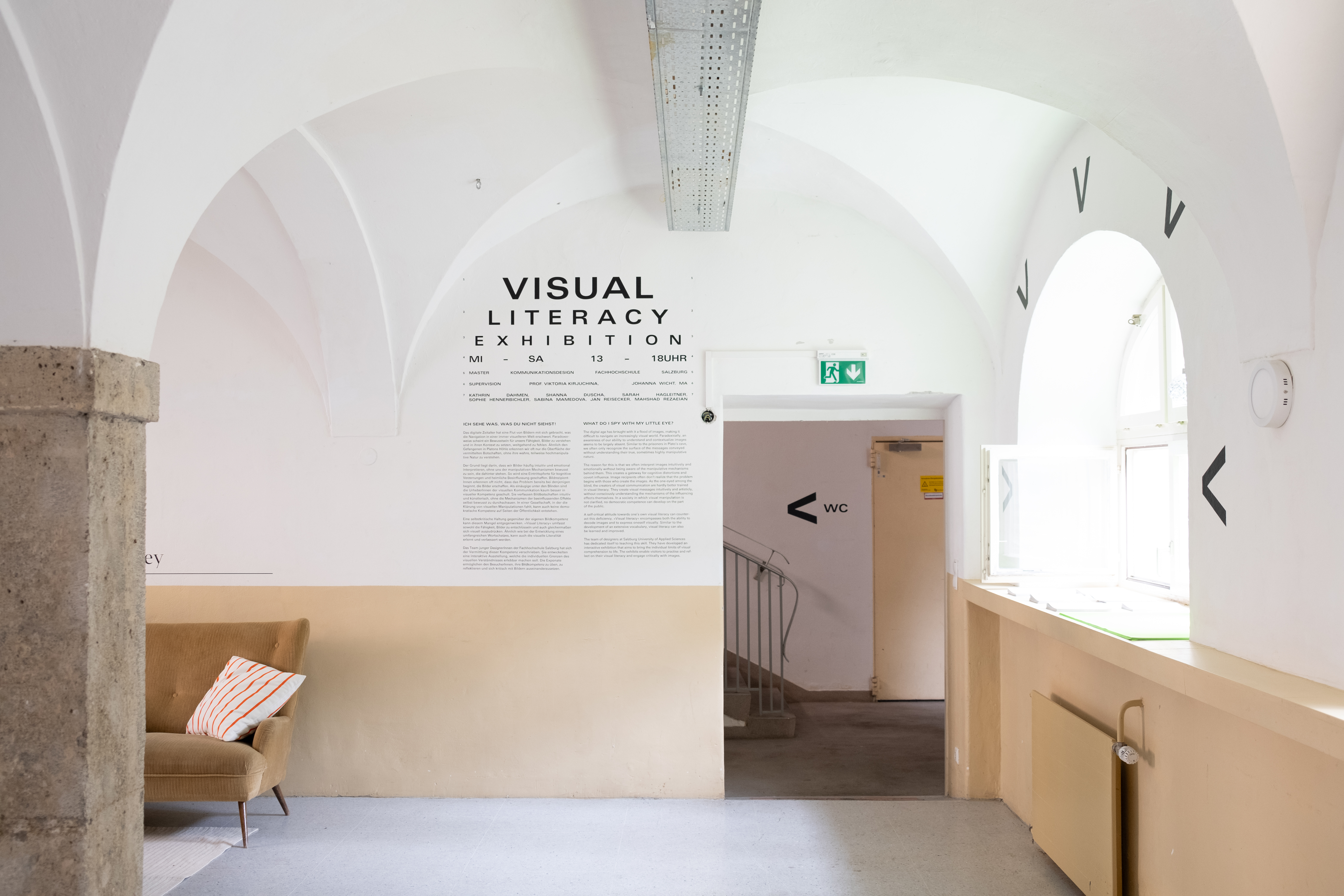

I See Something You Don’t See!
The digital age has produced a flood of images, making it harder to navigate an increasingly visual world. Yet awareness of how we understand and contextualize images is largely missing. Like the prisoners in Plato’s cave, we often perceive only the surface of messages without recognizing their true, sometimes highly manipulative nature.
We tend to interpret images intuitively and emotionally, unaware of the manipulative mechanisms behind them. This opens the door to cognitive bias and subtle influence. The problem already begins with image creators, who—like the one-eyed among the blind—are often insufficiently trained in visual literacy themselves. They craft visual messages intuitively and artistically without fully understanding their persuasive effects. Without critical reflection on visual manipulation, democratic competence cannot develop within the public.
A self-critical approach to one’s own visual competence can address this gap. Visual literacy includes both decoding images and expressing oneself visually, and—like vocabulary—it can be learned and improved.
We as Designers at Salzburg University of Applied Sciences developed an interactive exhibition to make the limits of visual understanding tangible. The exhibits invite visitors to practice, reflect on, and critically engage with images.